America's $38.8 Trillion Gamble
The US national debt is $38.8 trillion. Up until now, GDP growth has been just enough to service the interest and keep the lights on. It’s been teetering on the edge of the Japan scenario: either shrink the economy to pay it down, or print money and hope everyone else keeps buying your currency. The petrodollar arrangement, where Gulf states price oil in USD, has been doing the heavy lifting. Arab nations park their money in American assets, America gets to run deficits that would bankrupt any other country.
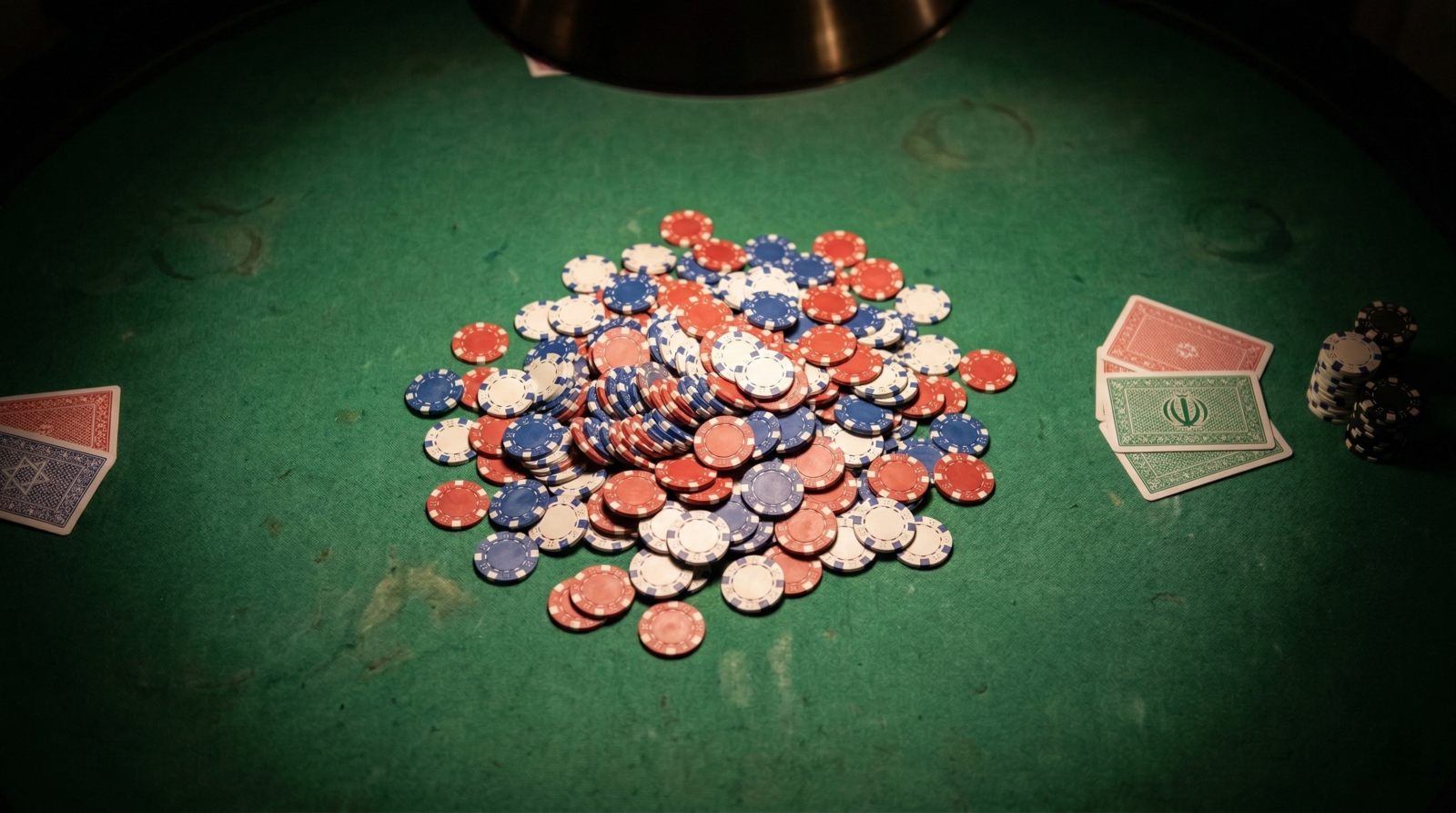
That arrangement is now under direct threat.
The sunk cost
Twenty years of post-Iraq military buildup. Raytheon, Lockheed, the entire defence-industrial complex, trillions in accumulated spending with a $38.8 trillion debt to show for it. At some point, the logic flips from “can we afford this?” to “how do we make this pay off?”
I think that’s the conversation happening in Washington right now. Cuba, Venezuela, Greenland, Canada (yes, Canada). And now Iran. It’s a trigger-happy leader trying to brute-force his way out of a structural economic problem. Take the oil. Take the land. Take the minerals. Make the guns pay for themselves.
It’s ugly, but it tracks.
Why Iran is the linchpin
If the Islamic Republic falls, the strategic map redraws itself overnight.
Iran is a critical node in China’s Belt and Road Initiative, the Central route land bridge connecting China to West Asia. Take that out, and Beijing’s westward expansion is effectively blocked. The discounted oil China gets from Iran stops flowing. The calculus on Taiwan changes, because the US has just demonstrated it will use overwhelming force and China’s energy supply chain got a lot more fragile. Some analysts argue Taiwan’s sovereignty could be effectively guaranteed for another generation.
Russia’s International North-South Transport Corridor runs through Iran. Sever that, and Moscow loses its southern outlet. The US suddenly has a chokehold on Russia without needing a single base near Russian territory. I’d expect Russia, already overstretched in Ukraine, would face mounting pressure to negotiate.
If Iran falls, the proxy network collapses. Yemen, Hezbollah in Lebanon, Hamas. Israel becomes the unchallenged regional power, which is what it has always wanted to be.
This is a massive win scenario for the US and Israel. And it’s not unlikely.
But if Iran survives
This is the part people aren’t thinking through.
If Iran weathers this, absorbs the strikes, and comes out the other side with its government intact, the consequences for America are catastrophic.
Gulf states are already reviewing $2 trillion in US investments. Saudi Arabia, the UAE, Kuwait, and Qatar are examining whether force majeure clauses let them pull out. They haven’t formally withdrawn yet, but the signals are loud. The logic from their side is straightforward: the US says it protects us, but it doesn’t. Missile stocks are depleting and America isn’t replenishing them for Arab states, while rushing a $151.8 million emergency arms sale to Israel, bypassing congressional review. On top of a $6.67 billion package approved in January. Everything is sacrificed for Israel. If you’re sitting in Riyadh or Abu Dhabi, the message is clear.
THAAD systems that were protecting Gulf assets are being pulled and redeployed. One radar in Jordan was destroyed by an Iranian missile. They’re even pulling THAAD from South Korea, which should tell you how stretched things are.
If the Gulf states decouple from the USD, if they strengthen ties with the EU and China instead, that alone accelerates the debt crisis. The dollar’s status as the world’s reserve currency is America’s real weapon, more than any missile. If that erodes, the whole thing starts looking like a paper tiger.
The isolation
Look at who’s distancing themselves. Norway’s foreign minister explicitly called the strikes a breach of international law. Switzerland said the same, and they’re now debating whether to formally invoke neutrality law, which would ban US military aircraft from Swiss airspace. France warned it risks undermining global stability. Even Canada, America’s closest ally, with Carney calling it a “failure of international order” and saying the strikes “appear to be inconsistent with international law.” (Though it’s worth noting Canada is quietly providing targeting intelligence while publicly wringing its hands, which is its own kind of ugly.)
The EU can’t agree on a unified position. France distances itself, Germany backs the strikes, the UK hedges. But the direction of travel is clear: the US launched this war without consulting its allies, and those allies are now figuring out how much distance they need.
Meanwhile, Trump’s “Board of Peace” is meant to replace the UN in some de facto sense. The members? Netanyahu, Lukashenko accepted. Putin was invited but skipped the first meeting. This is supposed to be the new international order. War criminals setting the rules.
Make or break
If Iran falls, the US is meaningfully stronger. China is contained. Russia is squeezed. Israel is the regional hegemon. The debt starts to look manageable because you’ve secured the oil and the trade routes.
If Iran survives, and manages to build alliances out of this, Iran goes from being one of the most sanctioned countries in the world to one of the most strategically important. On par with Germany, France, maybe more. China backs them. Russia backs them. The Gulf states realign. The petrodollar weakens. The $38.8 trillion debt starts looking like what it actually is.
This is the highest-stakes bet the United States has ever made. The entire world order hangs on whether Iran’s government survives the next few weeks. And nobody voted for it.
Good luck to us all.